November 14, 2025
Ghosts of the Mountains: Tracking the Future of Alberta’s Wolverines
By Jacqueline Louie
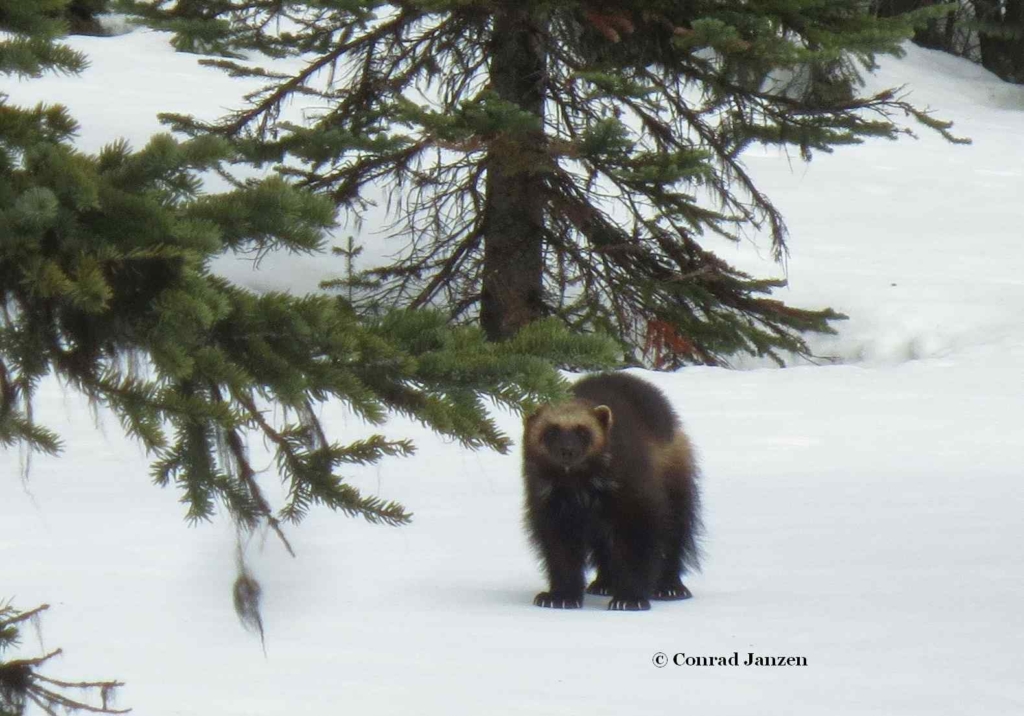
Image: Wolverine at the Owen Duchesnay Col, photo by Conrad Janzen
Wolverines are elusive creatures, seldom seen. People are lucky to spot this icon of the Canadian wilderness — whether it’s a wolverine loping across a mountain road, or deep in the backcountry. For wildlife biologist Mirjam Barrueto, who’s been studying wolverines for more than a decade, the wolverine — a large member of the weasel family — is “so cool and mysterious.”
“They have this wild reputation,” says Barrueto, who is with Wolverine Watch, an independent research group that encourages wolverine conservation through research and education.
Wolverines dwell in the northern reaches of Eurasia and North America, including the Canadian Rockies. One of the things that draws Barrueto — who’s done a lot of ultra-running, ski touring and climbing — to the wolverine, is that these animals are constantly on the move. They can cover huge distances — easily dozens of kilometres in a day, especially on snow. They’ve been spotted on top of mountain peaks. Their home ranges cover anywhere from 100 –500 square kilometres of territory for females, and up to 1,000 – 2,000 square kilometres for males. “They are strong, tenacious animals,” Barrueto says.
Small and light, wolverines weigh in at anywhere from 14 – 18 kilograms — “but they have the biggest attitude.”
Barrueto recounts the story of two mountain guides who had a memorable encounter with a female wolverine. They had gone skiing, high up in the mountains near Lake O’Hara, in Yoho National Park, and had safely cached their food by hanging it between two trees. When they returned to their camp, they saw a small wolverine standing underneath the cache. “She had decided that it was hers. She snarled and hissed at them, trying to make them go away. These are big, strong men … They were impressed.”
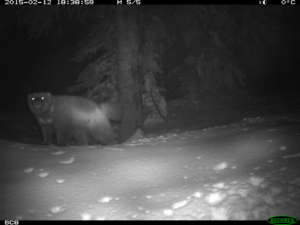
Mirjam Barrueto/ wolverinewatch.org
Usually, though, if you are ever lucky enough to spot a wolverine in the wild, “it will usually run away, like a ghost,” Barrueto says. “They are really shy. If you see them, the moment you react, they’re gone.”
In the past, all of the Rocky and Columbia Mountains were once wolverine habitat. Today, however, wolverines are absent from many places. Barrueto —who holds a Master of Science in evolutionary biology from the University of British Columbia and a PhD in ecology from the University of Calgary — wanted to find out why.
There are many different demands on the landscape, she notes. Forestry, going to the mountains, recreating in the mountains, running a business that serves tourists and outdoor recreation enthusiasts — it’s all beneficial and valuable for people, she emphasizes. People need to get outdoors for their mental and physical health and well-being. And the many different businesses that cater to them bring economic activity and growth.
At the same time, animals such as the wolverine, that make their home in the mountains, are vulnerable. Wolverines are very sensitive to human presence, relying on large, connected wilderness areas to thrive.
In her research, Barrueto wanted to clearly understand the threats for wolverines: what are the factors that pose a real issue, and what could potentially be managed, in order to give them the best possible environment in which to thrive?
“We know that trapping is a problem, we know that highways can be a barrier, and we have indications that tourists and recreation impacts them,” Barrueto says. “I wanted to figure out, does it impact them to the point where they stop having babies? And does recreation impact the number of animals there are?”
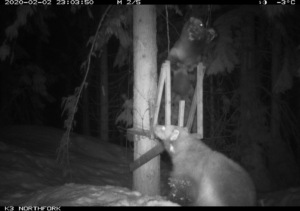
A female wolverine and her growing kit visit a research station — a rare glimpse into family behaviour.
Mirjam Barrueto/ wolverinewatch.org
She and her colleagues put out sampling stations, from 2011 – 2021, to collect hair samples from wolverines to systemically calculate their numbers. “The biggest question, was how many are there?”
(Governments, in the past, haven’t studied wolverines, she notes — the jurisdictions are just too small to get realistic numbers).
Barrueto and her colleagues sampled nearly all wolverine habitat across the southern Rockies and southern Columbia Mountains, west of the Rocky Mountain Trench, around Nelson and Cranbrook, B.C. For her PhD, she then did additional work sampling the Rockies and northern Columbias from Banff and the Bugaboos all the way to Mount Robson and Wells Gray Provincial Parks.
“In the southern areas, we found a fraction of what we had thought there would be, and that was a real surprise.”
The researchers found that the wolverine harvest in this region, which at the time was legal in most of B.C. and Alberta, was too much. “The population is really small; any trapping is too much trapping,” Barrueto says. “And only managing the impacts from recreation, forestry and other industrial activities is not enough if we don’t address trapping.”
The most recent population estimate for wolverines in Alberta, in a study published in December 2024,* was well under 1,000 individuals — sufficient to consider the species threatened.
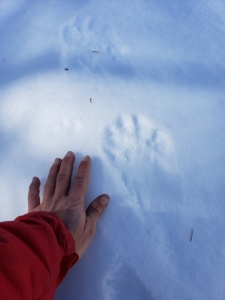
Mirjam Barrueto/ wolverinewatch.org
“The declines in density in the most protected areas of western Canada over the last decade (Barrueto et al. 2022) do not bode well for wolverines dealing with the many working landscapes in Alberta, where development has been occurring at a rapid pace for the last few decades,” write the authors of An Estimate of Wolverine Density for the Canadian Province of Alberta in the journal, Ecology and Evolution.
One reason that wolverines are so vulnerable, Barrueto explains, is that juvenile mortality is high. “Even if a female has two kits in a year, the chances that her babies will survive into adulthood are not high. Probably for young wolverines, the best thing that people can do for them is to leave them alone, as much as possible, during this crucial time in their lives.”
Female wolverines give birth in January or February, typically at treeline, in a den site where the kits can stay safe and warm. In April, as her babies are growing, the mother might need to take them to another location with plentiful food sources for her to hunt (typically animals such as marmots, ground squirrels and porcupines).
Barrueto’s project was the first in Canada to examine a 10-year trend in wolverine populations, and the findings are particularly significant for Alberta, she says. The study results are sobering: even in the best protected areas, it shows the wolverine population is declining. Barrueto found the wolverine population had declined 40 per cent from what it had been a decade ago — even in the national parks and surrounding areas. “That was a big eye opener. It’s not what we had hoped to find, but it’s also something we can address.”
There are a number of reasons for the population decline, she says: One, is the wolverine harvest. Two, Canada’s national parks are not very big, at least from a wolverine’s perspective, in terms of the amount of territory they need to thrive and successfully reproduce. Three, there seems to be some indication that very busy areas, with significant human presence, end up with fewer wolverines. According to Barrueto, it appears that female wolverines aren’t as successful with reproduction in places where there are a lot of people.
She points to a study conducted from 2010 – 2015, in which researchers in Idaho looked at how outdoor recreation — including ski touring and snowmobiling — affected wolverines. They found that wolverines — especially females — avoided busy areas, in terms of human presence. “As we go to the mountains, humans are always having an impact,” Barrueto says. “They found that these animals stay away from people, and when the people are gone, the animals come back.
What Barrueto and her colleagues know from other researchers, is that many of the den sites where female wolverines have their young, remain stable through time. “So if land managers — whether it’s parks, the provincial government, or in some cases commercial enterprises — could find those important places where they have their young, it will be very simple to stay away from them,” Barrueto says. And it doesn’t have to be a big deal or cause a lot of problems for people, she emphasizes. For example, it could mean asking people to avoid a particular mountain drainage for a certain period of time; or limiting the number of people who could enter that area within a specific time frame, and requiring them to stay on trail to create predictability for the animals.
In Banff National Park, Barrueto estimates there are currently about five to seven reproductive female wolverines. This means, she explains, that it wouldn’t be necessary for land managers to deal with a lot of areas in order to make a positive impact. There are very specific things that can done, with practical, manageable recommendations to governments on what they should do, and what they don’t need to worry about, Barrueto says.
“What we at Wolverine Watch see, is a way to mitigate a lot of the recreation side, whether it’s commercial or private recreation,” Barrueto explains. If researchers could focus on finding those denning areas that are important for female wolverines, (in places where people go), and designate those areas, the manager in charge could limit access at certain times of the year, to give the animals peace, for example between February and June —designating areas where wolverine families can be undisturbed after the kits are born.
“If we can step in to designate those places and governments put these protections in place, then we can mitigate the impacts before the species gets endangered — doing things that can be done now, while it’s easy, rather than waiting until it’s bad.
“There is a measurable impact of recreation on wolverine numbers. Because we’re working with all of these other people, we also know there are good solutions that are not overly restrictive or burdensome. And if governments, communities and companies that use those landscapes come together and decide to do something, we have a solution for this particular species.
“Yes, we found some uncomfortable results, but we’re also working hard with other people to make sure we offer a solution. That’s a really hopeful position to be in.”
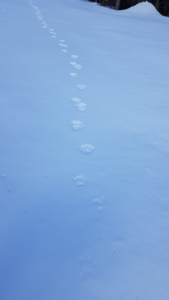
Mirjam Barrueto/ wolverinewatch.org
Sidebar:
In Alberta, there’s been a recent significant change in how wolverines and other fur-bearing animals are managed, with the Alberta Ministry of Forestry and Parks removing trapping limits in the fall of 2024 on fur-bearing animals (fisher, lynx, river otter and wolverine) on public lands (Registered Fur Management Areas).
According to the Alberta Wilderness Association’s Wild Lands Advocate Winter 2024 issue, Wilderness Watch), this change is “a regression on decades of sustainable management practices.”
“I think it’s very frustrating, very sad, and a real regression in our trying to keep a sustainable population out there,” says Calgary-based naturalist, broadcaster and author Brian Keating, owner of Goingwild.org and coproducer of Greatbignature.com. “To me, it’s shocking and very disappointing. It’s an unbelievable time we live in, that a small population of people, who essentially trap as a hobby — nobody is making a living from any of this — can go out and do the kind of cruelty that trapping and snaring enables. It just doesn’t make sense, to have a system in place that doesn’t pay attention to the science.
“There is nothing more thrilling than having an encounter with a wolverine, a marten, or a fisher when you’re in the backcountry of Alberta. To have an encounter with any of those fur-bearing animals, you never forget it.”
Keating has encountered many wild animals over the course of decades of hiking, mountaineering and skiing in the remote Canadian backcountry. He’s seen wolverines about half a dozen times: one of the first, was during an avalanche awareness course in the Lake Louise area of Banff National Park. “We looked to the left, and there was a wolverine scrambling straight up a couloir.”
Keating’s most recent encounter was a couple of years ago, hiking off the beaten track in larch terrain in the Lake Louise–Moraine Lake area. “We heard what we thought might have been a grizzly bear coming towards us,” he recalls. In a split second, he grabbed his binoculars, which he carries at the ready in a pouch on his belt. “Right away, I got a face full of two wolverines.”
A wolverine specialist he spoke with afterward told Keating it was probably a wolverine parent, a mom, practicing tough love on her kit, letting it know it was time to get lost — to move off and find its own territory. “They stopped maybe 15 to 10 meters in front of us, coming out of the understory. They both looked at us and we could see their little brains going, ‘Oh s—‘ — and they turned around and left. It was really something.”
To experience the wild, “it’s just a matter of being out there,” Keating observes —and understanding your surroundings, and the logic of being quiet when you’re in the wilderness (the human voice travels an unbelievable distance when you’re out in nature, he explains).
“These experiences stay with you forever.”
Wolverine Watch
Have you seen a wolverine in the Canadian wild?
Wolverine sightings or wolverine signs — including tracks, scat, or dens — can be reported to Wolverine Watch at https://www.wolverinewatch.org/ Public sightings help Wolverine Watch protect wolverine maternal dens, a key element in protecting wolverine families and future.
Resources:
The Wolverine Way, by Douglas Chadwick
https://www.goodreads.com/book/show/7888737-the-wolverine-way
https://www.cbc.ca/news/canada/calgary/alberta-wolverine-todd-loewen-bill-abercrombie-fisher-1.7406335
* Research article, Ecology and Evolution — An Estimate of Wolverine Density for the Canadian Province of Alberta
https://onlinelibrary.wiley.com/doi/full/10.1002/ece3.70702




