March 7, 2025
The Return of the Bison: Restoring Banff’s Wild Heritage
Written by Jacqueline Louie
For thousands of years, plains bison roamed not just the Prairies, but also the land that
is now Banff National Park.
Situated just west of Canmore, Banff National Park is a special place. Archaeological
evidence points to plains bison historically occupying the area now known as Banff
National Park.
After European contact, the bison disappeared from the landscape for 150 years. Their
absence was part of a continental-scale near-disappearance of an entire species.
“The big thing, is that bison were historically present here forever — since the last ice
age, 10,000 years ago —and they disappeared in the 1880s,” says Banff-based
conservationist Harvey Locke, author of The Last of the Buffalo Return to the Wild and
cofounder of the Yellowstone to Yukon Conservation Initiative (Y2Y), supporting large-
scale land conservation and the long-term ecological health of the region along the
spine of the Rocky Mountains.
In the 19th century, the vast bison herds of the Prairies seemed limitless. Their
disappearance was part of a broader pattern of the extinction of large mammals in the
19th century, Locke explains. The bison were overhunted, and the terrain they lived on,
the Prairies, was heavily cultivated and fenced off, squeezing the bison out of their
habitat.
“The loss of the bison was not only an ecological tragedy, but also a cultural tragedy,
because of their significance to First Nations people,” Locke says. ”It’s also a
conservation failure for a native species to be missing from a national park—the
ecosystem is not complete without bison.”
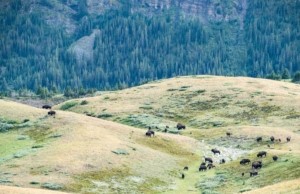
In the 1890s, the bison became the first symbol of conservation in Banff, with the
reintroduction of a small herd of captive bison, which remained in the Banff Buffalo
Paddock for about a century.
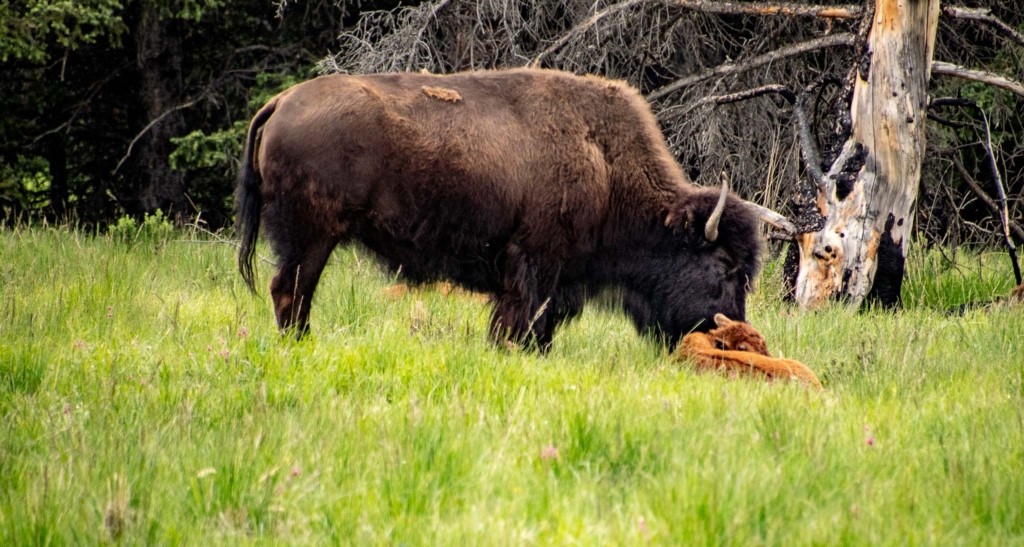
Now, bison roam freely in Banff’s remote backcountry, thanks to a Parks Canada
initiative that’s a success story on many levels.
After a long period of consultation, in 2017 Parks Canada brought 16 plains bison —
comprising 10 pregnant cows and six bulls — from Elk Island National Park east of
Edmonton, to Banff National Park. They were held in a contained area as they became
accustomed to their new surroundings, and were then released into the wild in 2018.
Today, approximately 130 bison make their home in a 1,200-square-km area in Banff
National Park’s northeastern backcountry.
“Bison are a keystone species, meaning they play a really important role in the rest of
the ecosystem,” says Dillon Watt, bison reintroduction project manager for Banff
National Park.
Bison are important for many, many other species —including plants, animals, birds and
insects, he explains. Bison positively impact plant communities, such as meadows,
helping maintain meadows by reducing shrub encroachment, through a combination of
grazing and physical disturbance. They also benefit carnivores —mostly wolves and
grizzly bears—as a good food source. Bison wallowing in the ground cause depressions
that serve as beneficial microhabitats for insects, amphibians and birds. Bison hair is
used by birds to line their nests in springtime. Even bison dung is important, as a
resource for a huge array of insect communities.
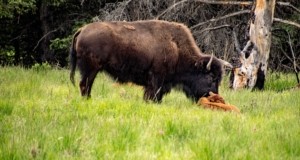
“All of these components are intricately linked. It’s a really special thing to be able to
restore a key piece of this whole system,” Watt says. The reintroduction of the bison, a
key native grazing species, is expected to change the park ecologically, he adds. “What
it does, is contribute to the resilience of the system, and all of that feeds into ecological
integrity.”
Locke, too, points to the importance of the role of the bison in the bigger picture: they
are running free on the landscape and performing an ecological function. “A major
ecological process has been restored to the park. There’s a whole range of ways that
bison serve in the landscape. And nature only thrives when ecological processes are
intact.
“Parks Canada is one of the leading bison conservation organizations in the world, and
the Banff Park bison reintroduction is significant, because it’s the restoration of a group
of bison in the wild, in a park that everybody in the world has heard of, so it has
attracted global attention. The park is more complete with wild bison. It’s part of
restoring the ecological integrity of the park. It’s important to the mandate of the park,
and it’s important to the global effort to halt and reverse biodiversity loss. And not only is
it conservation, it’s also reconciliation,” Locke says.
Adds Watt: “I think the pilot project has shown us that through bison, there’s this
possibility to improve and restore ecosystems, while at the same time restoring these
really important cultural connections” (for Indigenous peoples).
The Banff bison reintroduction is a key part of Parks Canada’s contribution to
international bison conservation, with the Banff herd one of only five free roaming plains
bison herds in their historic range and exposed to the pressures of natural selection,
such as predators, in North America. “It’s one of the most incredible stories in
conservation — that these animals were saved from extinction, and are ultimately now
living in places like Banff and returning to their role in those ecosystems,” Watt says.
Callout box:
Heritage Park in Calgary is hosting a traveling exhibit, Bison, toured by Kauffman
Museum on behalf of the National Buffalo Foundation, open at Heritage Park’s Gasoline
Alley until May 19.
Resources:
The Stoney Bison Study:
https://stateofthemountains.ca/state-of-the-mountains-blog/banffs-bison-reintroduction-
project-a-cultural-update
The Bison Cultural Project, conducted by the Stoney Consultation Team of the Stoney Tribal
Administration:
https://www.canadianmountainnetwork.ca/research/bison-cultural-project
https://a.storyblok.com/f/112697/x/d0b9253d5a/stoney_bison_report_final_rev2.pdf
Reintroducing bison to Banff National Park — an ecocultural case study, by Karsten
Heuer, Jonathan Farr, Leroy Littlebear and Mark Hebblewhite
file:///C:/Users/Owner/Downloads/fcosc-04-13059321.pdf
Parks Canada
https://parks.canada.ca/pn-np/ab/banff/info/gestion-management/bison
https://parks.canada.ca/pn-np/ab/banff/info/gestion-management/bison/blog
https://parks.canada.ca/pn-np/ab/banff/info/gestion-management/bison/faq
Yellowstone to Yukon
https://y2y.net/




